Map tool
How loud is it at this address?
The official environmental noise map gives a day and a night value for any address in northern Burgenland, where a survey was made. We queried it at 30 places, one per municipality with a zone. The most important figure is not the loudest value but the gap: of 3.436 inhabited residential locations only 396 carry a zone, and 18 of the 48 municipalities are entirely blank.
Enter an address or tap the map
Our per-location analysis: only INHABITED 250-metre cells are coloured, woodland, vineyards, fields and the lake stay blank. Pale cells are below the mapping threshold or outside the surveyed area. In this market the second case is by far the more common one: almost nine in ten residential locations carry no zone. Source: strategic environmental noise map 2022 (laerminfo.at, Austrian Ministry of Climate Action), road and motorway noise. Rail and air traffic noise are not surveyed for this market.
How to read the map
The map shows the continuous sound level in bands of 5 decibels: once averaged over the whole day (Lden, weighted for evening and night) and once for the night alone (Lnight, 22:00 to 06:00). Green means two different things here: below the mapping threshold of 55 dB by day or 45 dB at night, OR outside the surveyed area. In northern Burgenland telling the two apart matters more than in any other of our markets, because the second case clearly predominates.
- below 55 dB
- Quiet or not surveyed. Eighteen of the 48 municipalities carry no zone at all, among them Antau, Bad Sauerbrunn, Baumgarten, Leithaprodersdorf and Loipersbach. There green says nothing about quiet, only that nobody measured.
- 55 to 64 dB
- Audible but ordinary. Neufeld an der Leitha, Marz, Oslip and Poettsching sit in this band. It is thinly populated because the map here knows almost only the main axes, and those carry higher values.
- 65 to 74 dB
- Loud. The band of the lakeside villages and the Wulka corridor: Neusiedl am See, Purbach, Breitenbrunn, Jois, Donnerskirchen, St. Margarethen, Rust, Kleinhoeflein and Trausdorf. Usually it is the federal road right at the edge of the village.
- above 75 dB
- Very loud, the highest band on the scale. It occurs in eleven municipalities, across 18 cells in total: Eisenstadt itself, Grosshoeflein, Hornstein, Klingenbach, Mattersburg, Muellendorf, Neudoerfl, Siegendorf, Sieggraben, Winden am See and Wulkaprodersdorf. Almost always the A3 motorway or a busy federal road runs there.
Rule of thumb: most people perceive 10 dB more as twice as loud. And the night counts for more than the day, for sleep Lnight is the more important value. This is where this market holds its biggest surprise: six municipalities are louder at night than the provincial capital. Grosshoeflein, Hornstein, Klingenbach, Mattersburg, Muellendorf and Wulkaprodersdorf sit at 70 to 74 dB, Eisenstadt itself at 65 to 69.
When does it officially count as too loud?
The thresholds are set in the federal environmental noise protection act and differ by source. They are not limits in the sense of a ban, but the point from which the state must draw up action plans.
| Source | Day (Lden) | Night (Lnight) |
|---|---|---|
| Road | 60 dB | 50 dB |
| Motorway and expressway | 60 dB | 50 dB |
| Rail | 70 dB | 60 dB |
| Air traffic | 65 dB | 55 dB |
| Industry (IPPC installations) | 55 dB | 50 dB |
For this market only the first two rows really matter. We queried an evenly spread sample of 57 of the 396 zone-bearing cells: road noise in all 57, motorway noise in 29, rail noise in none at all. At 21 of the points road and motorway overlap, which is the A3 south-east motorway.
What the map can and cannot do
- Green here usually means “not surveyed”
- Of 3.436 inhabited residential locations in the market, 396 carry an official zone, so 11,5 per cent. In our other markets it is 11 to 40 per cent, which puts Eisenstadt second from last of nine. Eighteen of the 48 municipalities are entirely blank, at 37,5 per cent the highest share of all our markets. No zone is no statement about quiet here.
- The railway is missing although it runs
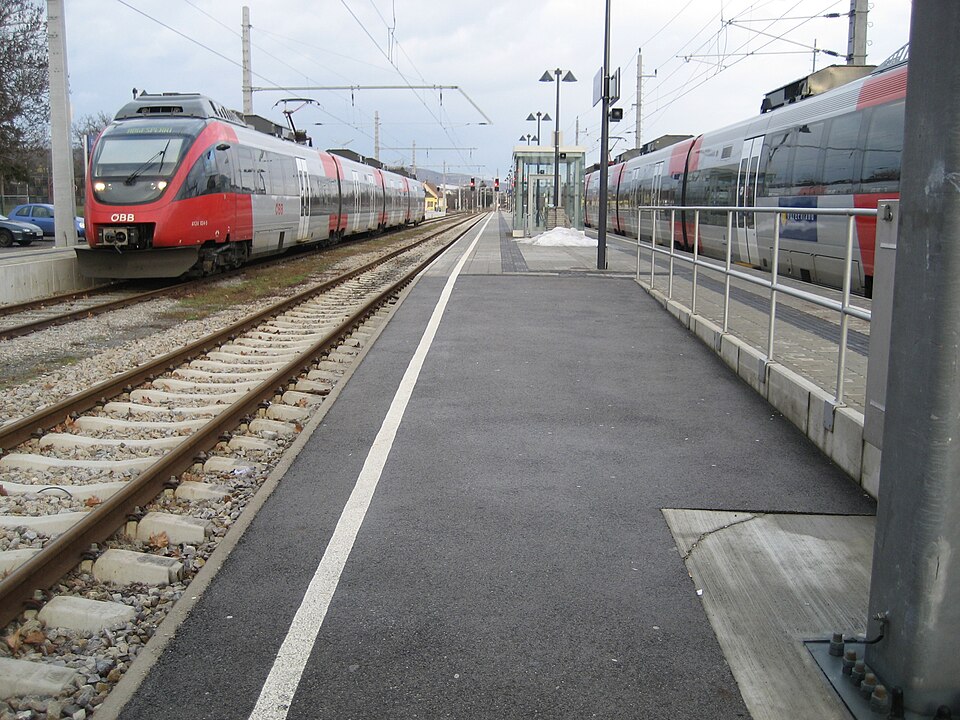
- The Vienna to Sopron line via Eisenstadt and the Mattersburg line both cross this market. In our sample of 57 zone-bearing cells not a single one carries a rail zone, and the source does not appear at any of the 30 loudest places either. Strategic mapping covers railway lines only above a yearly train count these lines do not reach. Anyone living by the tracks will find nothing about it on the map, and that does not mean no train runs there.
- Six municipalities are louder at night than Eisenstadt
- Grosshoeflein, Hornstein, Klingenbach, Mattersburg, Muellendorf and Wulkaprodersdorf carry 70 to 74 dB at night, the provincial capital 65 to 69. Sorting this market by quiet does not sort it by settlement size but by how close the A3 and the federal roads run.
- No agglomeration
- The EU environmental noise directive names 100.000 inhabitants as the threshold for area-wide mapping. Austria has designated five agglomerations: Vienna, Graz, Linz, Salzburg and Innsbruck. Eisenstadt has 14.816 inhabitants and is the smallest provincial capital in the country. We queried the official layer at all 30 points of the market, everywhere without a hit. That is exactly where the thin coverage comes from: only the main traffic axes are mapped here, not the area.
- Air traffic noise is not surveyed, and that had to be checked
- A major airport lies nearby here, and Vienna-Schwechat certainly is mapped. Measured, however, the market’s closest inhabited residential location is 19,1 kilometres away, in Purbach am Neusiedler See, and at the twelve nearest residential locations the official service reports no air traffic zone at all. The contours do not reach into the market.
- Industrial noise is not surveyed
- Industrial installations subject to permits (IPPC) are mapped only in the five agglomerations. No industrial zone is therefore available for this market. That does not mean there is no plant noise, only that nobody surveyed it across the area.
- Traffic only, and outdoors only
- The map knows nothing of neighbours, guest gardens, building sites, wine festivals or harvesters. It also computes the level at the façade, not inside the flat: windows, floor and which side of the building change the result considerably. If the tapped point lies in no zone, the analysis takes the loudest zone within roughly 15 metres, so the street side, and says so.
Quiet hours in Burgenland: what applies where?
Burgenland has no province-wide quiet hours with clock times. The Burgenland provincial security act says in section 3(1) only: “It is prohibited to create disruptive noise or offensive odour in an improper manner.” No time of day appears there. What applies in practice is decided by the municipality.
The enabling provision is section 6(1)(2)(a): the municipality may set temporal and local restrictions by ordinance for “garden and other working equipment”, so lawnmowers, leaf blowers, circular saws. Section 6(4) expressly requires consideration for agriculture, and in a wine-growing region that is no formality: harvest, spraying and bird deterrence cannot be moved to fit a lunch break.
What that means for you
- Ask the municipal office for the ordinance
- We found no published noise protection or quiet hours ordinance for Eisenstadt. That does not mean none exists, only that it was not findable online. In a market of 48 municipalities the rule changes at every municipal boundary anyway, and only the respective municipal office can give binding information.
- The general prohibition applies even without an ordinance
- Even where no municipal ordinance exists, nobody may create improperly disruptive noise. Noise is improper when it lacks the consideration required in living together and was avoidable. That is a judgement in the individual case, not a decibel value.
- Agriculture is expressly taken into account
- Under section 6(4) a municipal ordinance must have regard to agriculture. In the lakeside villages and the Wulka valley that means tractors, harvesters and acoustic bird deterrence in the vineyards are not a disturbance within the meaning of the act, even when they start early.
- Building sites follow building law, not quiet hours
- Construction work is governed by the conditions of the building permit and by trade law, not by the municipality’s garden equipment ordinance. Anyone disturbed should turn to the municipal building authority, not to the police.
Breaching section 3(1) is an administrative offence: under section 32 of the Burgenland provincial security act a fine of up to 500 euro, and in case of non-recovery a substitute custodial sentence of up to four weeks. The district administrative authority is responsible, in Eisenstadt the city magistrate.
These statements were checked against the federal legal information system (as at 12 September 2026) and are no substitute for legal advice. In case of doubt your municipality’s ordinance overrides any general information.
Air traffic noise: Schwechat is close, but not close enough
Vienna-Schwechat airport is a major airport and is mapped area-wide under the environmental noise directive. The obvious question is whether its contours reach into northern Burgenland. We did not estimate that, we measured it.
The market’s closest inhabited residential location to the airport lies in Purbach am Neusiedler See, 19,1 kilometres as the crow flies. At the twelve nearest residential locations, spread across Purbach, Leithaprodersdorf and Winden am See, the official service reports no air traffic zone at all.
That does not mean an aircraft is never heard over Lake Neusiedl. It means the level there lies below the threshold from which the official map draws anything. Anyone wanting to see the actual flight paths will find them at the airport itself, not on this map.
The same applies at night: no air traffic zone anywhere in the market, not even in the lakeside villages.
Frequently asked questions
Why is there no value for my address?
Because nothing was surveyed there. In the Eisenstadt market only 11,5 per cent of inhabited residential locations carry an official zone, and 18 of the 48 municipalities are entirely blank. Almost only the A3 and the busy federal roads are mapped here. A missing value therefore does not mean “quiet”, it means “not measured”.
Is Eisenstadt the loudest municipality in the market?
By day it shares the highest band with ten others. At night it does not: Grosshoeflein, Hornstein, Klingenbach, Mattersburg, Muellendorf and Wulkaprodersdorf sit at 70 to 74 dB, Eisenstadt at 65 to 69. What decides is not settlement size but proximity to the A3 and the federal roads.
Why is there nothing about the railway line on the map?
Strategic environmental noise mapping covers railway lines only above a certain number of trains per year. The Vienna to Sopron line and the Mattersburg line do not reach it. In our sample of 57 mapped residential locations not a single one carries a rail zone. Trains run nonetheless.
Can you hear Vienna airport in Purbach or Neusiedl?
Not on the official map. The market’s closest inhabited residential location lies 19,1 kilometres away, and at the twelve nearest ones no air traffic zone is drawn. Individual overflights can of course still be heard, they simply lie below the threshold from which mapping starts.
When may I mow the lawn in Burgenland?
Your municipality decides. The Burgenland provincial security act names only the general prohibition of improperly disruptive noise in section 3(1), without a time of day, and empowers the municipality in section 6(1)(2)(a) to set times for garden and other working equipment. For Eisenstadt we found no published ordinance, so ask at the city magistrate.
What does a breach cost?
Under section 32 of the Burgenland provincial security act, up to 500 euro, and in case of non-recovery a substitute custodial sentence of up to four weeks. Both breaching a municipal ordinance and, even without any ordinance, creating improperly disruptive noise under section 3(1) are punishable.
Is there a decibel limit for noise from neighbours?
No. For neighbourhood noise the law names no decibel value; decisions follow what is locally customary and whether the usual use of the flat is substantially impaired. The decibel thresholds on this page apply to the traffic noise of the official map, so 60 dB by day and 50 dB at night for roads.
Does the map show the noise inside the flat?
No, it computes the level at the façade. Floor, window quality and which side of the building change the result considerably: between the street side and the courtyard side of the same building there is easily 10 to 15 dB, and most people perceive 10 dB as half as loud.
Official map data: 2022 (next EU round: 2027) · Source: laerminfo.at (Austrian Ministry of Climate Action), CC BY · Quiet hours: Burgenland provincial security act, sections 3, 6 and 32, version in force as at 12 September 2026 (RIS) · Agglomeration status, mapped sources, airport distance and coverage queried by us, September 2026