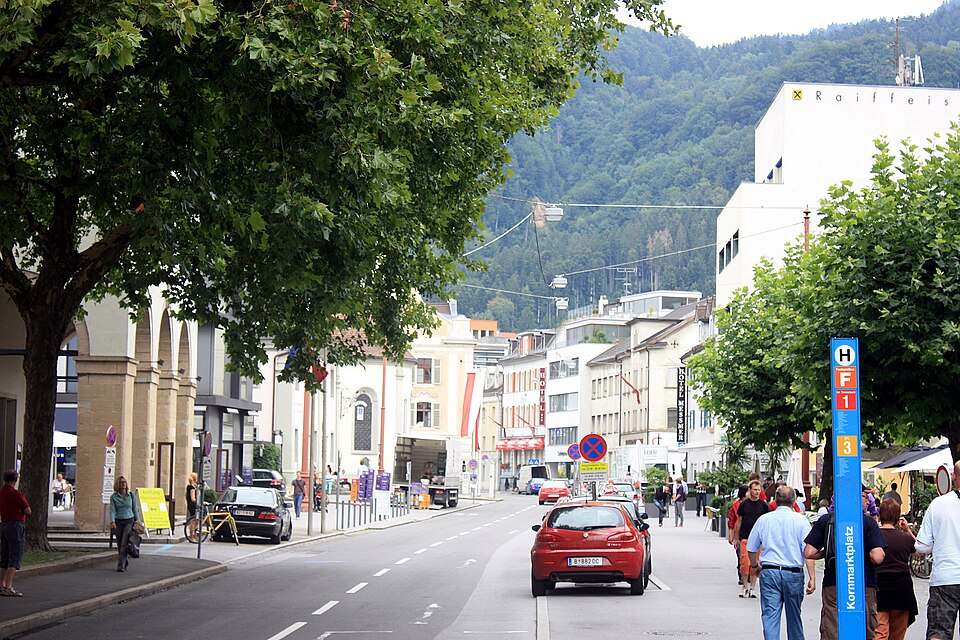
Commercial property in Bregenz: space that fits your business.
We do not yet have a single commercial space on offer in Vorarlberg, and we do not show what does not exist. What is already there is the location data for every address between Bregenz and Feldkirch: footfall, catchment, official traffic noise and Vorarlberg zoning in plain words. List a space and it carries exactly those figures.
Office, retail, hospitality, storage or studio: filtered by use, every location with its commercial fit. If nothing suits today, the search saves an alert.
The commercial fit: the space has to match the business
A residential yardstick does not help with commercial space: what spoils a home often makes the turnover. The commercial fit therefore reads every location through the lens of your business model, with real data per 250-metre cell instead of a blanket score.
Retail & hospitality: choose on footfall data
Match factors
Footfall 0 to 100: the centre of Bregenz has a median of 99.5, Vorkloster 84, Rieden-Weidach 82.5. The market's top locations, though, are spread out rather than in one city
Catchment: how many people reach the space in 10, 15 and 20 minutes, and here that turns out differently than the population figures suggest
Vorarlberg zoning in plain words, with the legal note: in a core area the permitted retail floor space is in the plan to the square metre
Official traffic noise for day and night, and the honest statement about where nothing was surveyed at all
Reachability for staff and clients: real travel times by transit, bike, car and on foot
A quiet micro-location as far as the map knows it: the Rhine valley is not an agglomeration, 14.8 per cent of cells are mapped. Where no zone lies, we say so instead of selling silence as quiet
Heat load of the location, computed from the sealed-surface share: a different figure on the valley floor than on the slope
Parking, ceiling height and fit-out as hard criteria
The commercial fit weighs differently from the residential one: reachability and footfall count most, climate more moderately. Every score is broken down to the individual factors.How the fit is calculated →
Reachability for customers and staff: calculated, not guessed
For a commercial space it is not the address that decides but who reaches it. The reachability calculator shows real travel times for every space: by transit from the timetables of the Vorarlberg transport association and the ÖBB, by car, bike and on foot over the real road network, not as the crow flies.
In the Rhine valley the towns sit closer together than the map suggests: Dornbirn is 15.8 kilometres away and 11 transit minutes from Bregenz station, exactly as far as Bregenz's own Achsiedlung. The neighbouring municipality of Möggers, 8 kilometres away as the crow flies, needs 100 minutes and is therefore not part of the market at all. On top of that the catchment: how many people reach the space in 10, 15 and 20 minutes, computed from timetable and building density.
TransitCarBikeOn foot
The same data, read for your business
wohnwahn uses the same official and open sources for living and for commercial space. The fit reads them differently depending on the perspective: what devalues a flat can upgrade your location.
A market without one centre
For living
Pleasant: footfall in the centre of Bregenz has a median of 99.5, and anyone looking for quiet finds it two streets away.
For your business
The 154 cells with a footfall of 90 or more spread across eight places: 28 in Dornbirn, 26 in Feldkirch, 12 each in Lustenau, Hohenems, Hard and Götzis, 8 in Rankweil and 7 in the centre of Bregenz. Here you choose the TOWN, not the street.
Lustenau and the dense middle of the valley
For living
Densely built, little space between houses, and the border brings traffic.
For your business
The largest catchment in the market: around 35,000 people within 10 transit minutes, 74,000 within 15. The Leutbühel reaches 10,000 and 18,000.
On the A14 and the arterial roads
For living
The loudest places in the market: a clear deduction for living.
For your business
Visibility and access. For retail on an arterial road, for a workshop and for storage that is exactly what counts.
Zoning names retail floor-space caps
For living
Irrelevant for a flat.
For your business
Decisive for retail: in a Bregenz core area the permitted total retail floor space is in the plan to the square metre, with its own cap for groceries. That appears in no listing.
The environmental noise map of the Federal Environment Agency, the official flood indications and the zoning service of the province of Vorarlberg. What the Rhine valley does not have we say openly: it is not an agglomeration, the noise map covers only main traffic routes and reaches 14.8 per cent of the cells. There is no official climate map, so heat comes from the sealed-surface share. There is no tree register. Zoning, by contrast, Vorarlberg supplies in plain words with plan reference and legal note, and we pass it on.
Our own routing
wohnwahn computes travel times and catchments itself: from the timetables of the Vorarlberg transport association and the ÖBB and from the real road network, not from straight-line distance.
Honestly broken down
Every commercial fit is traceable down to the individual factors: location, price, climate, reachability. No polished marketing number. And where a source is missing, we say so instead of estimating.
Market a commercial property in Bregenz successfully
Your space deserves more than a line in a portal. wohnwahn presents it with the figures that convince commercial tenants: footfall, catchment, traffic noise, zoning and reachability for customers and staff. Free, straight from your agency software or by direct entry.
For agents, owners and property managers · free, no commission
Frequently asked questions about commercial space in Bregenz
Where is the best footfall in the Rhine valley?
In the centre of Bregenz, but the answer is incomplete if you stop there. We compute footfall per 250-metre cell from 0 to 100: the centre has a median of 99.5, Vorkloster 84, Rieden-Weidach 82.5. The market's TOP locations, however, are spread out. Of the 154 cells at 90 or above, 28 are in Dornbirn, 26 in Feldkirch, 12 each in Lustenau, Hohenems, Hard and Götzis, 8 in Rankweil and only 7 in the centre of Bregenz. The Rhine valley has no centre, it has eight.
How many people reach a unit at the Leutbühel?
Around 10,000 within 10 minutes, 18,000 within 15 and 38,000 within 20, computed from timetable and building density. That is less than the provincial capital suggests: from Lustenau it is 35,000 within 10 minutes, from Dornbirn 23,000, from Feldkirch 12,000. Anyone who needs footfall should put those figures side by side before settling on the best-known name.
Does wohnwahn show the zoning of a commercial space in Vorarlberg?
Yes, and here the information is unusually good. The province keeps the zoning plans of all municipalities plot by plot and publishes them in plain words, with plan reference and legal note. For retail that is no detail: in a Bregenz core area the permitted total retail floor space is in the plan to the square metre, with its own cap for groceries. The binding document remains the municipality's plan.
How loud is a commercial space in the Rhine valley?
Where it was surveyed we say it exactly: the loudest point in the market is the Marktgasse in Feldkirch, the Leutbühel in Bregenz comes to 55 to 59 dB. Where nothing stands, we write that down: with 29,270 inhabitants in the core town the market is not an agglomeration, so the environmental noise map covers only 14.8 per cent of the cells. The market square in Dornbirn and the town hall in Lauterach carry no zone at all, and that does not mean quiet, it means not surveyed.
How many commercial spaces do you have in Vorarlberg?
None at the moment. The market is new with us, and we do not show a space that does not exist. The location data is there for every address all the same, and anyone offering a space lists it for free.