Map tool
Linz noise map: how loud is it at your address?
Enter your address and get the official noise levels for that exact spot: during the day and at night, where the noise comes from and whether it exceeds the limits. Linz is the only Austrian urban area where industrial noise affects entire residential districts, and the night map draws that zone larger than the day map. Useful before every viewing.
Enter an address or tap the map
Our own analysis per residential location: only INHABITED 250-metre cells are coloured, forest, fields and water stay blank. This layer covers road, motorway and rail. Industrial and aircraft noise appear in the address analysis above and in the official zone map, but not in this grid. Source: strategic environmental noise map 2022 (laerminfo.at, Austrian Ministry of Climate Action), road, motorway, rail, aircraft and industrial noise combined.
How to read the map
The map shows the continuous sound level in 5-decibel bands: once averaged over the whole day (Lden, weighted more strictly for evening and night) and once for the night only (Lnight, 10 pm to 6 am). Green means below the mapping threshold of 55 dB by day and 45 dB at night, so quiet as far as the official map is concerned.
- below 55 dB
- Quiet. Below the mapping threshold, typical for the pedestrian zone on Landstraße, for Froschberg, for Kleinmünchen away from the through roads and for the slopes of Pöstlingberg.
- 55 to 64 dB
- Audible, but usual on urban residential streets, around the main station, in central Urfahr and in Leonding along the railway line.
- 65 to 74 dB
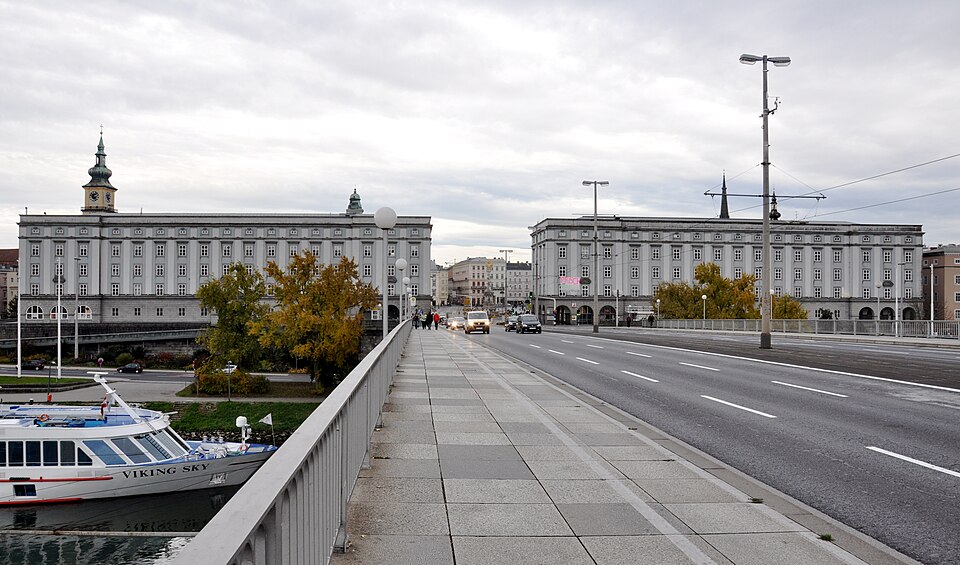
- Loud. Hauptplatz and the Nibelungen bridge, the homes above the covered A7 in Bindermichl and Spallerhof, the JKU campus on Altenberger Straße. Soundproof windows make the difference here.
- above 75 dB
- Very loud. Directly on the A7 Mühlkreis motorway and the A1 west motorway, and in the immediate surroundings of Hörsching airport.
Rule of thumb: most people perceive 10 dB more as twice as loud. And the night counts for more than the day, for sleep Lnight is the more important figure. That applies to Linz in particular, because the night map draws the industrial zone larger than the day map.
When is it officially too loud?
Two figures help with the context. The WHO recommends staying below 53 dB by day and 45 dB at night for road traffic. Austria additionally sets thresholds for action planning in its federal environmental noise protection act, and these depend on the source.
| Source | Day (Lden) | Night (Lnight) |
|---|---|---|
| Road | 60 dB | 50 dB |
| Motorway and expressway | 60 dB | 50 dB |
| Rail | 70 dB | 60 dB |
| Air traffic | 65 dB | 55 dB |
| Industry (IPPC plants) | 55 dB | 50 dB |
At 55 dB, industry has the strictest daytime value, rail at 70 dB the mildest. That is not arbitrary: a constant plant noise is considered more disturbing than a train passing by. If a threshold is exceeded, the responsible bodies examine noise protection measures, in Linz mainly the province of Upper Austria through its action plan and the city for its own roads. This does not create a legal entitlement to any particular measure. The analysis above places your address against exactly these values and uses the strictest one where several sources apply.
What the map can and cannot do
- Complete for the city, Leonding and Traun
- Linz is one of five Austrian urban areas. There every street down to residential access roads is mapped, plus rail, motorway, air traffic and industry. We queried each region individually: all 16 city districts as well as Leonding and Traun lie inside the urban area. A green area there really does mean quiet.
- Patchy outside the urban area
- Beyond it only the major traffic sources are mapped. In Gramastetten, Altenberg, Luftenberg, Wilhering, Ottensheim, Puchenau, Steyregg, Ansfelden, Enns, Asten, Pasching, Hörsching, St. Florian and Engerwitzdorf, green may therefore also mean "not surveyed" rather than guaranteed quiet. On Pöstlingberg, in the middle of the mapped area, quiet really is quiet.
- Noise protection becomes visible
- Where the A7 is covered over in Bindermichl and Spallerhof, the map shows no motorway zone, while a few hundred metres to the north it reaches 70 to 74 dB. The noise above the covered section comes from the surface streets, not from the motorway. A gap in the motorway band is not a flaw in the map here, it is its result.
- Industry only in the official layer
- Our residential grid and the quiet ranking cover road, motorway and rail. The industrial noise from voestalpine appears in the address analysis above and in the "Official zone map" layer. If you are looking in the south or east of the city, compare both views.
- Trams are missing as a separate source
- Linz has four tram lines and the Pöstlingberg railway. Upper Austria's action plan lists them as a noise source, but the published zone maps have no dedicated layer for them. On pure tram sections such as Landstraße or in Auwiesen the map therefore shows no rail zone, only road noise.
- Traffic and industry only, no neighbours
- Mapped are road, motorway, rail, air traffic and industrial plants requiring a permit. Bars, building sites, neighbours or the beer garden next door do not appear.
- Calculated, not measured
- The official map is modelled from traffic and plant data (EU Environmental Noise Directive), not measured at each address. For orientation that is very reliable.
- Courtyard versus street side
- The value applies to the grid cell. A courtyard-facing flat on a loud axis can still be quiet, and only a viewing will tell you (open the windows!).
- Address point inside the building
- A geocode usually sits in the middle of the building, while the noise zone ends at the facade. If the point itself lies in no zone, the analysis takes the loudest zone within about 15 m, so the street side, and says so.
Quiet hours in Linz: what actually applies?
Unlike Graz, where a dedicated ordinance sets fixed times for drilling, hammering and mowing, Linz has no such city-wide rule. What applies is Upper Austria's police penal act: under section 3 (1), anyone causing unreasonably disturbing noise commits an administrative offence, around the clock. Under section 10 the fine is up to 360 euros.
Noise is unreasonable when it lacks the consideration one can expect from someone. Each case is judged individually, more strictly at night and on Sundays and public holidays. Fixed times such as 10 pm to 6 am therefore usually appear in the house rules, and those apply because the rental or purchase contract refers to them. Building sites follow separate rules from their permit, not the police penal act.
What you can do about noise
- Talk first
- Many cases resolve themselves because the neighbour has no idea how far the sound carries. A period building in the Andreas Hofer quarter transmits impact noise surprisingly well.
- Call the police for acute noise
- For unreasonable noise here and now the police are responsible (emergency number 133). They assess the situation on site and can file a report under section 3 of the police penal act.
- City administration for businesses and building sites
- Linz is a statutory city, so its administration is also the district authority. It is the right place for noise from a permitted business, from the beer garden next door or from a building site.
- Province of Upper Austria for traffic noise
- For the noise this map shows, the province's environmental protection department is responsible. It runs the environmental noise action plan and the noise protection programmes along provincial roads.
- House management for ongoing noise
- For recurring noise write to the house management, with the date and time of each incident. A noise log is the most important piece of evidence if things go further.
- Reduce the rent
- If noise makes the flat considerably less usable, for instance during months of construction, a rent reduction under section 1096 of the civil code may be possible. The amount is not set by law, it depends on extent and duration. Get advice first: the Upper Austrian Chamber of Labour and the tenants association advise free of charge.
There is no decibel limit for neighbourhood noise. Decisions follow what is locally customary and whether the usual use of the flat is substantially impaired (section 364 (2) of the civil code). Anyone living next to the railway in Franckviertel has to accept more than someone in a cul-de-sac on Froschberg. Decibel thresholds only apply to the traffic and industrial noise on this map.
This summary is orientation, not legal advice. And it concerns neighbourhood noise, which the map above does not show: there it is about road, motorway, rail, air traffic and industry.
What about aircraft noise?
Linz airport is in Hörsching, a good ten kilometres south-west of the city. That is clearly visible on the map: of the 6,724 inhabited locations in the Linz area, not a single one inside the city carries an aircraft zone. Affected are 24 per cent of residential locations in Hörsching, 8 in Pasching and 2 per cent in Traun.
Air traffic has a threshold 5 dB higher than road traffic, so 65 dB by day and 55 dB at night. That is not playing it down, it follows the assessment in the federal environmental noise protection act. More important for context is the metric itself: Lden averages over the whole year. A single approach is loud for about a minute and disappears in the annual average. So anyone living under the flight path clearly hears the individual aircraft, even where the map shows only a mild zone.
It is worth checking the wind direction before a viewing in Hörsching, Pasching and the west of Traun. The runway runs east to west, and take-offs and landings use one side or the other depending on the weather. Linz is also an important cargo airport, and cargo flights fall into the marginal hours more often than passenger flights.
For the night: Linz airport operates from 5:30 am on weekdays and from 6:00 am at weekends until 11:00 pm. Operations therefore extend into the map night window (10 pm to 6 am) at both ends, and the official night map therefore shows an aircraft zone for the night as well.
Industrial noise: the Linz special case
voestalpine and the chemical park are mapped separately as IPPC plants, and in the affected locations the analysis above names "industry" as the source. At 55 dB by day and 50 dB at night they carry the strictest threshold of all sources: a steady plant noise is considered more disturbing than a train passing by. For comparison, measured at every inhabited residential location, the number lying in an industrial zone by day or night is 191 in the Linz area, 32 in the Vienna area, 17 in the Graz area, 4 in the Salzburg area and 2 in the Innsbruck area.
Of the 6,724 inhabited locations in the Linz area, 150 lie in an industrial zone during the day and 180 at night. The share of residential locations in a zone, from day to night: in Industriegebiet-Hafen from 68 to 70 per cent, in Spallerhof from 18 to 40, in Franckviertel from 28 to 39 and in Kleinmünchen-Auwiesen from 7 to 16 per cent. In Bulgariplatz, in Pichling and in Traun, a zone appears at night where none is mapped during the day. Only 112 of them reach the threshold for industrial noise at night (from 50 dB), all 150 during the day: the day map only starts at the 55 dB threshold, the night map already at 45.
That the night map draws the zone larger is mostly down to this scale and to the metric: the all-day value Lden adds 5 dB to the evening and 10 dB to the night. A plant that runs equally loud around the clock therefore sits about 6 dB lower at night than its Lden, so the 55 dB line of the day map corresponds to roughly 49 dB at night, and the night map already draws from 45. The official 2022 exposure analysis counts 5,300 people affected nationwide in the daily average and 14,300 at night, almost three times as many.
If you are looking in the south or east of Linz, the night map is more informative than the day map. Switch to "Night" above and compare.
Frequently asked questions about the noise map
What is a noise map?
A noise map shows how loud a place is on annual average, calculated from traffic and plant data rather than measured at every address. The EU requires member states to produce one every 5 years, covering road, motorway, rail, air traffic and industry. It shows the continuous sound level in 5-decibel bands, separately for the whole day (Lden) and for the night (Lnight). Neighbourhood, bar or building-site noise is not included.
Where does the noise data for Linz come from?
From Austria's strategic environmental noise map (laerminfo.at, Environment Agency on behalf of the Ministry of Climate Action, data from 2022, CC BY). For the urban area the municipal roads were surveyed, plus provincial roads, motorways, railway lines, Hörsching airport and industrial plants requiring a permit. wohnwahn additionally evaluates the map per inhabited 250-metre cell.
What do Lden and Lnight mean?
Lden is the continuous sound level averaged over 24 hours, with evening and night weighted more strictly (day-evening-night). Lnight is the average for the night hours from 10 pm to 6 am only. For restful sleep Lnight is the more important figure.
How many locations in Linz are affected by noise?
In our analysis of the official map, of the 6,724 inhabited 250-metre cells in the Linz area about 74 per cent lie below the mapping threshold, 17 per cent between 55 and 64 dB and just under 9 per cent at 65 dB or above. Most affected are Bulgariplatz and Franckviertel with 45 and 44 per cent of their locations at 65 dB or above, quietest is Pöstlingberg with 91 per cent below the threshold.
Does the map cover the whole city of Linz?
Yes. Linz is an official urban area, so every street down to residential access roads is mapped. We queried each region individually: all 16 city districts as well as Leonding and Traun lie inside the mapped area. A green area in the city therefore really does mean quiet. It is different outside: in Gramastetten, Altenberg or Wilhering only the major traffic sources are recorded, and green may also mean "not surveyed".
Does the map show noise from voestalpine?
Yes. Industrial plants requiring a permit are mapped separately, and in the affected locations the analysis above names "industry" as the source. Note that the night map draws the industrial zone larger than the day map. The share of residential locations in a zone, from day to night: in Industriegebiet-Hafen from 68 to 70 per cent and in Spallerhof from 18 to 40 per cent. Our residential grid and the quiet ranking, by contrast, only cover road, motorway and rail, so for industrial noise the "Official zone map" layer is the right one.
Why is the industrial zone larger at night than during the day?
Mostly because of the scale of the map. The night map starts at 45 dB, the day map only at 55, and the all-day value Lden adds a surcharge to evening and night: a plant that runs equally loud around the clock sits about 6 dB lower at night than its Lden. Above the threshold, 112 locations in the Linz area lie at night (from 50 dB) and 150 during the day (from 55 dB). Nationwide the official analysis counts 5,300 people affected by industrial noise in the daily average and 14,300 at night.
My street feels loud but the map shows green. Why?
The map only knows traffic and industrial sources. Bar noise, refuse collection, building sites or a busy lane are not mapped. Trams are missing too: Upper Austria's action plan lists them as a source, but the published zone maps have no dedicated layer for them.
Are trams included in the noise map?
Not as a separate source. Linz has four tram lines and the Pöstlingberg railway, but the published map service has no dedicated layer for them. We queried pure tram sections such as Landstraße and Auwiesen: there the map shows no rail zone, but road noise. Rail noise covers the west line, the Summerau line and the Pyhrn line.
Does the map also show aircraft noise?
Yes, but Linz airport is in Hörsching, so outside the city. Of the inhabited locations inside the city, not a single one carries an aircraft zone. Affected are 24 per cent of residential locations in Hörsching, 8 in Pasching and 2 per cent in Traun. The map also shows a zone at night there, because operations run until 11 pm and start as early as 5:30 am on weekdays.
Can I see the noise level for a specific listing?
Yes. Every listing on wohnwahn shows the location data for its address, and if you choose "quiet home" in the fit, you get the official noise band for that address directly in the match explanation.
At how many decibels do the authorities examine noise protection?
Under the federal environmental noise protection act, action planning uses thresholds of 60 dB by day and 50 dB at night for road and motorway noise, 70 and 60 dB for rail noise, 65 and 55 dB for aircraft noise and 55 and 50 dB for industrial plants. If a value is exceeded, the responsible bodies examine measures. This does not create a legal entitlement to any particular measure.
Until when may you be loud in Linz?
There is no city-wide ordinance with fixed times as in Graz. Upper Austria's police penal act prohibits unreasonably disturbing noise in section 3, around the clock; each case is judged individually, more strictly at night and on Sundays and public holidays. The fine is up to 360 euros. Fixed times such as 10 pm to 6 am are usually found in the house rules.
Is there a decibel limit for noise nuisance from neighbours?
No. For neighbourhood noise the law states no decibel limit; decisions follow what is locally customary and whether the usual use of the flat is substantially impaired. Decibel thresholds exist only for the traffic and industrial noise on this map, where they are 60 dB by day and 50 dB at night for road noise.
Official map data: 2022 (next EU mapping round: 2027) · Source: laerminfo.at (Austrian Ministry of Climate Action), CC BY · Quiet hours: Upper Austrian police penal act, sections 3 and 10 · Mapping boundary queried by us across all 32 regions, August 2026 · Industrial and aircraft zones measured at all 6,724 inhabited locations, 27 September 2026