Map tool
Innsbruck noise map: how loud is it at your address?
Enter your address and get the official noise levels for that exact spot: during the day and at night, where the noise comes from and whether it exceeds the limits. Innsbruck is the only city among our six markets where the official aircraft noise zone reaches inhabited districts, and it does so at night as well.
Tip: you can also tap directly on the map.
Our residential rating per 250 metres. Map: OpenStreetMap contributors, CARTO · Noise zones: laerminfo.at (Austrian Ministry of Climate Action), CC BY
What the numbers mean
Lden is a 24-hour average that weights evening and night more heavily. Lnight is the average between 10 pm and 6 am. Both are annual averages at the facade, not a snapshot: a single loud truck does not show up, a corridor with constant traffic does.
- below 55 dB
- Quiet, or not surveyed. Innsbruck is an official urban area and therefore mapped across its whole territory, so within the city an empty spot really does mean quiet. Igls, Vill and Hall in Tirol fall outside that boundary, where the same emptiness only means "not surveyed".
- 55 to 64 dB
- Audible but ordinary. This is the band of the residential streets on the valley floor, measured among others in Pradl, Amras, Saggen and Reichenau, and Maria-Theresien-Strasse also sits in this band. It is a long street and the values move within it: we measured 60 to 64 dB at its northern end and 55 to 59 at house number 18.
- 65 to 74 dB
- Clearly affected. This covers the main station, the university clinic on Innrain and, in the surrounding area, Voels and Zirl. Windows facing the street matter here, windows facing the courtyard often do not.
- 75 dB and above
- The highest band on the scale. In Innsbruck it is reached in the Wilten corridor, where motorway, railway and road come together, and close to the motorway in the east towards Amras.
The values apply at the facade and without windows. What arrives inside the flat depends on glazing, floor and layout: a bedroom facing an inner courtyard is often 20 to 25 dB below that.
When is it officially too loud?
Austria sets a threshold per source in its federal environmental noise regulation, above which authorities must consider action. It is neither a ban nor an entitlement, but it is the number that guides the action planning.
| Source | Lden | Lnight |
|---|---|---|
| Road | 60 dB | 50 dB |
| Motorway and expressway | 60 dB | 50 dB |
| Rail and tram | 70 dB | 60 dB |
| Air traffic | 65 dB | 55 dB |
| Industry | 55 dB | 50 dB |
The WHO recommends far stricter values for road traffic: 53 dB during the day and 45 dB at night. Applying those, you will find exceedances even in quiet Innsbruck locations. Mapping incidentally starts below the thresholds, at Lden 55 and Lnight 45.
What this map cannot do
- No construction, no neighbours, no bars
- The EU mapping covers roads, motorways, rail, air traffic and large industrial plants. A building site, a guest garden, an air conditioner or a neighbour with a drill do not appear in it, however loud they are.
- The mountain is not modelled
- The mapping models propagation over terrain, but reflection off the steep slopes of the Inn valley is exactly the effect residents describe and an annual average captures badly. On the valley floor it can feel louder than the number says.
- Annual average, not a summer night
- Lnight is averaged over the whole year. A summer with the window open on a through road is not described by it.
- As of 2022
- The map comes from the 2022 EU mapping round. A street rebuilt or calmed since then still carries its old values.
Quiet hours in Innsbruck
Tyrol has no statewide quiet hours. The state police act prohibits unreasonably disturbing noise without fixed times, and what counts as unreasonable is decided case by case. Specific times sit in municipal ordinances, and Innsbruck has one.
The noise abatement ordinance for the provincial capital of Innsbruck (city council resolution of 20 December 1976, city law 5/1) regulates four things:
What is prohibited when
- House and garden work
- Prohibited all day on Sundays and public holidays, and on working days from noon to 3 pm and from 8 pm to 6 am. Combustion-engine equipment and beating carpets, blankets and mattresses are named explicitly.
- Night quiet for audio devices
- From 10 pm to 6 am, radios, televisions and loudspeakers may only run in closed rooms and only quietly enough not to be heard outside the room.
- Snow-making equipment
- Prohibited from 10 pm to 6 am. Hardly any other city has this paragraph, and it says something about the location: snow-making reaches the residential fringe.
- Audio devices outdoors
- In the city public grounds and on its sports, play and camping sites and in its swimming facilities, audio devices are prohibited entirely, except at permitted events.
Anyone creating unreasonably disturbing noise commits an administrative offence punishable by a fine of up to 3,000 euros (section 4 paragraph 1 of the Tyrolean state police act). In Innsbruck the mayor is the responsible authority, elsewhere in Tyrol the district administration.
The exception in section 1 paragraph 2 matters: the times do not apply where a disturbance of others is ruled out by local circumstances. A detached house at the forest edge is a different case from a courtyard in Wilten.
Aircraft noise: the Innsbruck special case
In most Austrian cities aircraft noise is a marginal topic, because the airport lies far out and Lden is an annual average in which individual overflights disappear. Innsbruck is different, and that can be checked against the official map.
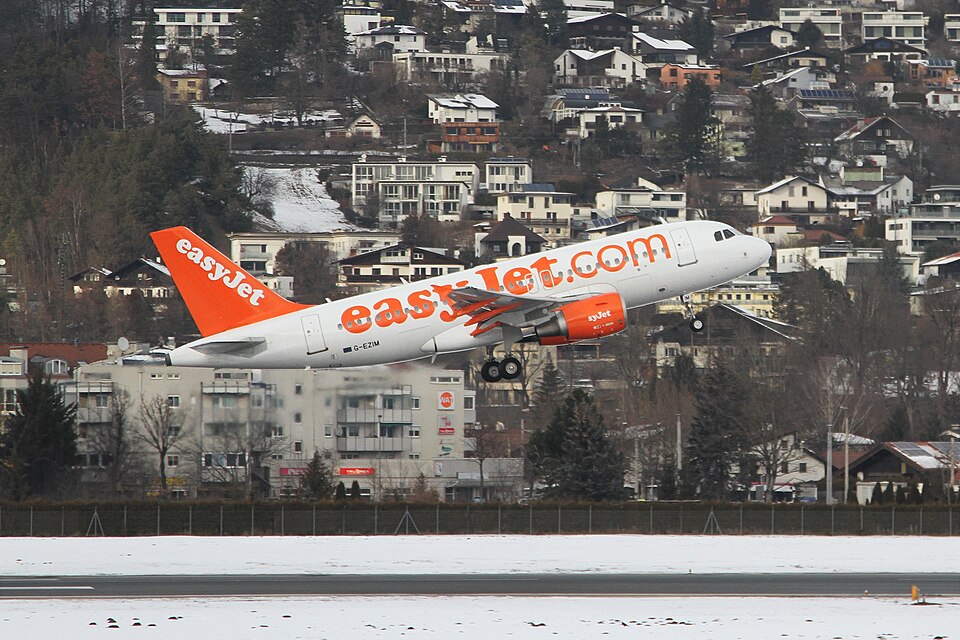
On 2 September 2026 we queried two residential points per market against the aircraft noise layers in all six markets. In Vienna, Graz, Linz and St. Poelten none of them carries an aircraft zone, neither by day nor at night. In Salzburg, Maxglan carries a daytime zone of Lden 55 to 59 and none at night. In Innsbruck, by contrast, Hoettinger Au sits at Lden 65 to 69 during the day and Lnight 50 to 59 at night, and even at the university clinic on Innrain, a good two and a half kilometres east of the airport, there are still Lden 55 to 59 and Lnight 45 to 49.
The reason is geography: the approach comes from the east across the city, and the sound is reflected off the slopes of the Nordkette and the Mittelgebirge. Along a west-east section the zone ends at about 11.375 degrees east, just short of the city centre. If you live west of that, take aircraft noise into your decision; east of it, essentially not.
Unlike Salzburg, the zone is present on the NIGHT map as well. We say what we know: the zone is mapped. How often aircraft actually fly at night is not something the map says, and the publicly available statements about operating hours contradict each other.
Frequently asked questions about the noise map
Where is Innsbruck loudest?
In the Wilten corridor, where motorway, railway and road meet. Lden exceeds 75 and Lnight exceeds 70 dB there, the highest band on both scales. It gets similarly loud near the motorway in the east towards Amras.
Is the city centre loud?
Less than you would think. Maria-Theresien-Strasse stays within the 55 to 64 dB band along its whole length during the day, and the old town itself carries no zone at all at the point we checked. It is a pedestrian zone, and the map shows that.
Does aircraft noise affect me?
That depends on how far west you live. The official zone runs from the airport to roughly the level of the university clinic on Innrain and ends before the city centre. Hoettinger Au and Kranebitten lie within it, Pradl, Saggen and Reichenau do not.
Does "no zone" really mean quiet here?
Within the city yes, because Innsbruck is an official urban area and mapped across its whole territory. Igls, Vill and Hall in Tirol fall outside that boundary: there only the main traffic sources are surveyed, and an empty spot only means nothing was surveyed.
Until when may you be loud in Innsbruck?
Noisy house and garden work is prohibited on working days from noon to 3 pm and from 8 pm to 6 am, and all day on Sundays and public holidays. Radios, televisions and loudspeakers must stay at room volume from 10 pm to 6 am. This is set out in the city noise abatement ordinance.
Is there a decibel limit for noise from neighbours?
No. The Tyrolean state police act states no decibel figure; it prohibits unreasonably disturbing noise. Each case is judged on its own, and the fine reaches 3,000 euros. The decibel values on this map apply to traffic and industry, not to your neighbour.
Official map data: 2022 (next EU mapping round: 2027) · Source: laerminfo.at (Austrian Ministry of Climate Action), CC BY · Our own point queries against the Environment Agency WMS, 2 September 2026 · Quiet hours: noise abatement ordinance of the provincial capital of Innsbruck, city law 5/1 (council resolution of 20 December 1976) · Penalty range: Tyrolean state police act, section 4 paragraph 1