Guide · Subsidised housing
Council flats in Vienna: ticket, points and process, as of 2026
Vienna owns around 220,000 council flats housing about half a million people, every fourth Viennese. The way in leads through the Vienna housing ticket (Wohn-Ticket), and that very system is being overhauled in 2026. Here is what applies now, what changes and how to judge your chances realistically.
What a council flat is
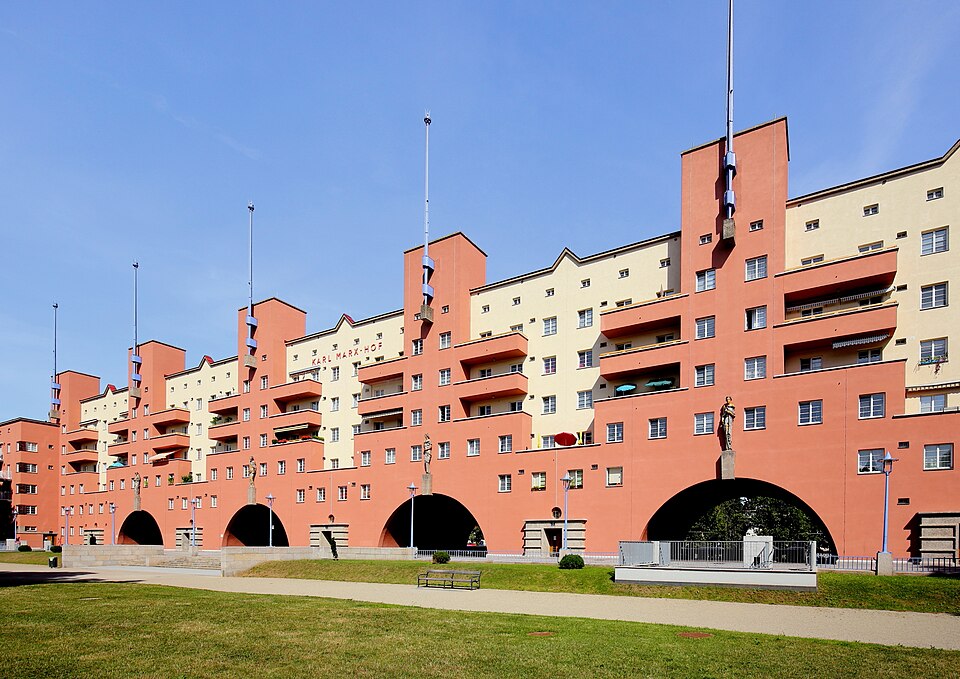
Council flats belong to the City of Vienna and are managed by Wiener Wohnen, Europe's largest municipal housing administration: around 220,000 flats in 1,800 estates. The Gemeindebau is a child of 1920s "Red Vienna"; its most famous piece is the Karl-Marx-Hof in Döbling, at a good kilometre one of the longest contiguous residential buildings in the world.
For tenants, three things matter: open-ended leases as the rule, no agent commission and mostly no upfront money. For the newly built "Gemeindewohnungen NEU" it is explicit: no upfront money, no deposit.
Requirements for the Vienna housing ticket
- Age of majority
- Minimum age 18 (in the new system; the lease itself always required 18).
- 2 years main residence in Vienna
- Continuously registered in Vienna, regardless of how many addresses (since May 2025 residence counts across addresses). Registration gaps of up to 7 days are tolerated.
- Citizenship
- Austria, EU/EEA or Switzerland, recognised refugees or the long-term residence permit "Daueraufenthalt-EU".
- Income limits (net/year, 2026)
- 1 person €61,280 · 2 persons €91,320 · 3 persons €103,330 · 4 persons €115,360, each additional person +€6,730.
- Affordability & household size
- New: the rent of the offered flat may not exceed 50 percent of household income, and household size must match the number of rooms.
- Clean tenancy record
- Court-ordered terminations (for example over rent arrears) trigger a 5-year ban; open debts with Wiener Wohnen must be settled.
The new bonus-point system (from 22 September 2026)
Whoever meets the requirements gets the ticket. Ranking for specific flats is decided by bonus points. A selection of the most important ones (once per household, with proof):
| Vienna bonus | up to 45 points | From the 6th year of continuous main residence, staggered 2 to 4 points per year. |
| Long active search | up to 45 points | Per year of active searching (at least 100 login days) without being ranked first, rising 5 to 15 points. |
| Young Viennese under 25 | 50 points | Without an own lease, future household of at most 2 people; expires at the 26th birthday. |
| Overcrowding | 50 points | For example 2 or more people in 1 room, 3 or more in 2 rooms. |
| Single parent | 30 or 80 points | 30 with an own lease, 80 without. |
| Separation / divorce | 40 / 50 points | For separated households after the end of a partnership. |
| Imminent loss of home | 30 to 80 points | From an expiring fixed term (30) to an owner-use termination or death of the main tenant without succession right (80). |
| Health & care | up to 100 points | Chronic mobility impairment 75 to 100, home care by care level 50 to 100, domestic violence 100. |
Status: City of Vienna allocation guidelines of June 2026 (version 5.4), which are continuously evolving; some points are mutually exclusive (the higher one counts). Holders of an old ticket with housing need receive a starting bonus of 10 to 45 points until the end of 2026.
How the allocation works
- 01
Register online
Free of charge on meinwohnticket.wien (until autumn 2026 in parallel via the Wohnberatung Wien). Confirm your data at least every 12 months, otherwise the ticket lapses.
- 02
Apply for flats
Available flats are posted online for 48 hours. You can apply for up to 3 flats at once; ranking follows bonus points.
- 03
View and decide
If ranked first, a viewing follows. Decide carefully: from the second rejection onwards there are bans of 3 months, from the fifth of 3 years.
- 04
Sign the lease
Acceptance or rejection, then signing and key handover at the Wiener Wohnen service centre. Afterwards a 3-year rest period applies for new applications.
What a council flat costs
New leases run at the regulated "Richtwert" rent: in Vienna 6.74 euros per square metre net (since 1 April 2026), plus service charges and 10 percent VAT. Wiener Wohnen gives as orientation for the total rent: from about 350 euros for 1 room, from about 520 for 2, from about 750 for 3 and from about 850 euros for 4 rooms.
There is no commission and mostly no upfront money, the biggest difference to co-op flats with their move-in contribution. How the Richtwert works in detail (and what private landlords may add to it) is covered in the Richtwert guide.
Regulated rents & location surcharge explained →
How long do you really wait?
The city does not publish an official waiting time, and it would be dishonest anyway: it depends on your bonus points, preferred district and supply. For context: Vienna allocates around 14,000 council and subsidised flats per year; averages reported in guides are roughly one and a half to two years. Flexibility on district and floor makes you much faster, and the new system rewards long active searching with up to 45 extra points.
Three paths beside the regular allocation
- Direct handover
- Whoever gives up a council flat may propose their successor (no family relation needed). The successor needs a matching housing ticket; for investments a compensation of at most 5,000 euros is allowed.
- Social housing allocation
- A separate path for difficult life situations (imminent homelessness, eviction, care by a social institution): after review there is a one-time offer of a small, low-cost council flat.
- Subsidised & SMART flats
- The housing ticket also covers subsidised new-build and SMART flats by housing developers, with capped upfront money (SMART: at most 60 euros per square metre). More in the co-op guide.
Co-op flats: the complete guide →
Common questions about council flats
How long is the wait for a council flat in Vienna?
There is no official number; it depends on bonus points, preferred district and availability. Vienna allocates around 14,000 council and subsidised flats per year; averages reported in guides are about one and a half to two years. Flexibility on location and floor shortens the wait considerably.
What are the requirements for the Vienna housing ticket?
At least 18 years old, 2 years of continuous main residence in Vienna (across addresses, registration gaps up to 7 days tolerated), Austrian, EU/EEA or Swiss citizenship or equivalent status, and household income below the WWFSG limits (2026: €61,280 net/year for 1 person, €91,320 for 2).
What about the "justified housing need"?
It is dropped with the new allocation system: from 22 September 2026, a bonus-point system replaces the housing-need categories (Vienna bonus, young Viennese under 25, overcrowding, single parents and more). Old tickets with housing need remain valid until autumn 2026 and earn a starting bonus.
What does a council flat cost?
New leases at the regulated rent (Vienna since 1 April 2026: €6.74/m² net) plus service charges and 10 percent VAT. Wiener Wohnen quotes on average from about €350 (1 room) to about €850 (4 rooms) total rent. No commission, mostly no upfront money.
Can I buy a council flat?
No. Council flats are rental flats owned by the City of Vienna with open-ended leases and are not for sale. Many co-op flats, by contrast, come with a purchase option.
I have lived in Vienna for one year. Can I register?
Not yet: it takes 2 years of continuous main residence in Vienna. Moving within Vienna no longer hurts since May 2025; only registration gaps of more than 7 days reset the clock.
How many offers may I decline?
You can apply for up to 3 flats posted online at once (offers stay online for 48 hours). Declining costs you: from the second rejection there is a 3-month ban, then 6 and 9 months, from the fifth 3 years.
Do I earn too much for a council flat?
The limits are higher than many think: €61,280 net per year for 1 person, €91,320 for 2, €103,330 for 3, €115,360 for 4 people (2026). Income is checked when the ticket is issued, that is, at access.
Read on
- Co-op flats: requirements & registration →
- Vienna housing benefit: requirements & application →
- Regulated rents: what pre-war flats may cost →
- Affordable living where it is worth it →
As of July 2026 · Based on the City of Vienna allocation guidelines (June 2026) and wienerwohnen.at · Orientation, not legal advice