DEList a propertyFind a property
Shortlist

Living · Topic

Where in Vienna do you live among wine taverns and vineyards?

Proximity to Heuriger taverns and vineyards per 250 m cell, from OpenStreetMap · as of: August 2026

Vienna is the only city of over a million people with serious wine-growing, and it happens in just a few edge districts. We measured, for every inhabited spot in and around Vienna, how close the Heuriger taverns and vineyards are (from OpenStreetMap, per 250-metre cell). The most wine-steeped place in our data is Döbling (1190), where 60% of residential spots sit within walking distance of taverns and vines.

It is not the vineyard on the empty hillside that counts, but what you can reach on foot from your home: from Grinzing and Nussdorf through Stammersdorf to Perchtoldsdorf.
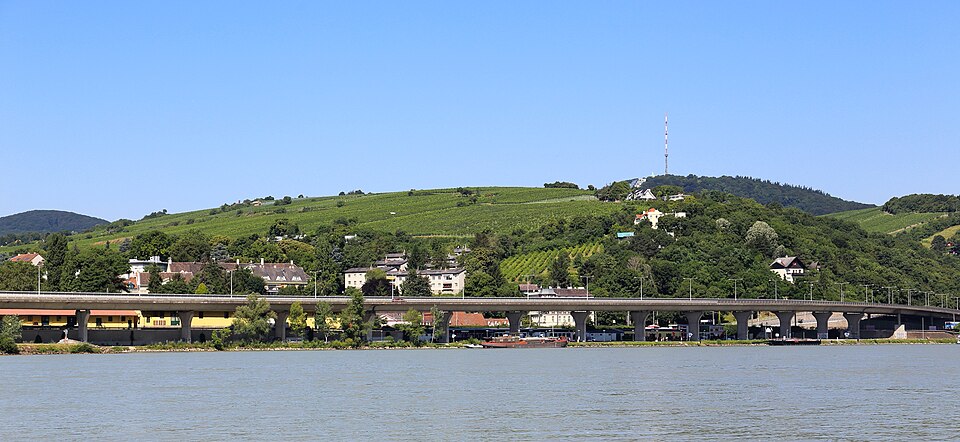
Döbling Nussberg, Wien
C.Stadler/Bwag · CC BY-SA 4.0

The wine map of Vienna and around

Deep burgundy means Heuriger taverns and vineyards close by. Every square is an inhabited 250 m cell with its wine-and-tavern proximity score (taverns count 60%, vineyards 40%).

no winewine country

Only inhabited cells are coloured. We measure proximity per home, never the share of vineyard land: the empty slopes on the Kahlenberg or the Perchtoldsdorf heath are never counted as a place to live. Tap the map for the score at that exact spot.

Where Vienna lives among wine

Ranked by the share of residential spots within walking distance of taverns and vines, Vienna districts and towns around the city together. Linked: the full profile in the atlas.

  1. 1
    Döbling1190
    median score 54· per spot 21–78· Stephansplatz ≈ 31 Min· buying ≈ € 9,060/m²
    60%of spots near wine
  2. 2
    Auersthal
    median score 41· per spot 19–68· Stephansplatz ≈ 74 Min
    55%of spots near wine
  3. 3
    Perchtoldsdorf
    median score 37· per spot 8–66· Stephansplatz ≈ 45 Min
    45%of spots near wine
  4. 4
    Baden
    median score 36· per spot 0–55· Stephansplatz ≈ 55 Min
    44%of spots near wine
  5. 5
    Brunn am Gebirge
    median score 31· per spot 0–63· Stephansplatz ≈ 45 Min
    39%of spots near wine
  6. 6
    Maria Enzersdorf
    median score 17· per spot 0–46· Stephansplatz ≈ 49 Min
    31%of spots near wine
  7. 7
    Mödling
    median score 23· per spot 0–42· Stephansplatz ≈ 42 Min
    27%of spots near wine
  8. 8
    Guntramsdorf
    median score 21· per spot 0–42· Stephansplatz ≈ 58 Min
    27%of spots near wine
  9. 9
    Langenzersdorf
    median score 1· per spot 0–42· Stephansplatz ≈ 35 Min
    26%of spots near wine
  10. 10
    Ottakring1160
    median score 20· per spot 0–38· Stephansplatz ≈ 25 Min· buying ≈ € 6,445/m²
    25%of spots near wine

Method: proximity of inhabited 250 m cells to Heuriger taverns (60%) and vineyards (40%) from OpenStreetMap, clipped to the real boundary. Only landuse=vineyard counts (never farmland), so Donaustadt and the Marchfeld stay at zero. The share is how much of a place is wine country; large districts like Döbling dilute over their wine-free centre, which is why the iconic wine villages are listed separately below. Prices: asking prices per m² (condos), immopreise.at / derStandard-Preisspiegel, as of Dezember 2025.

Vienna’s wine villages

A whole district averages out over its wine-free centre. The wine happens in its villages: from the famous ones in Döbling to the quieter Heurigen on the edge of the Vienna Woods (Dornbach, Wilhelminenberg) and on the Bisamberg (Stammersdorf). This is where the Heuriger culture actually lives.

Wine and still reachable

Wine usually means the edge of the woods. These spots combine it with a decent way into town: a lot of wine AND around 30 minutes from Stephansplatz by transit.

Honestly

The tavern data is not complete

Heuriger taverns and Buschenschank are tagged inconsistently in OpenStreetMap; some are missing or filed as an ordinary restaurant. We show what can be documented, plus the vineyards: individual taverns may be missing, which can nudge the ranking.

Open only when they are open

Many Heuriger open only seasonally (ausg’steckt is’). The map shows where they are, not whether they are pouring this week.

The vineyard is often above you

The big slopes on the Kahlenberg, Nussberg or Perchtoldsdorf heath are mostly uninhabited. We rate the proximity of homes to the vines, not living in the middle of a vineyard.

Beautiful is not cheap

The icons like Grinzing are lovely, well connected by the 38 tram, and touristy and pricey in summer. The ranking shows the wine, the atlas and the price line show the trade-offs.

Homes in the wine areas

Current rentals on wohnwahn, closest to taverns and vines first. A badge shows how wine-steeped the spot is.

See all listings in the search →

Frequently asked questions

Which Vienna districts have wine-growing at all?

Only a few edge districts. Döbling (19th) with Grinzing, Nussdorf, Neustift am Walde, Sievering and Salmannsdorf is the wine district. Plus Floridsdorf (21st) with Stammersdorf on the Bisamberg, Liesing (23rd) with Mauer and Favoriten (10th) with Oberlaa. There are small pockets on the edge of the Vienna Woods in Hietzing, Penzing and Währing. The inner districts and Donaustadt have no notable wine-growing (Donaustadt is Marchfeld farmland, not vineyards).

Where around Vienna do you live among vineyards?

Perchtoldsdorf and Klosterneuburg are the most significant wine towns in our data set. Perchtoldsdorf is a compact wine town on the Thermenlinie with many Heuriger taverns right in the village; Klosterneuburg is historically leading (its abbey runs Austria’s largest winery). Mödling and Maria Enzersdorf only have fringe locations and rank lower on purpose.

Why does Grinzing (Döbling) rank ahead, even though Stammersdorf has more vineyard area?

We weight Heuriger taverns more heavily than raw vineyard area (60 to 40 percent). For the living experience, the density of taverns within walking distance matters, not the square metres of vineyard on an uninhabited hillside. Grinzing has the densest concentration of Heuriger taverns in Vienna, so Döbling ranks at the top even though Stammersdorf has the larger contiguous vineyard area.

Does the huge vineyard area on the Kahlenberg and Nussberg count?

Only where inhabited spots lie nearby. We evaluate residential cells only and measure their proximity to vineyards and taverns, not the share of vineyard land. The empty hillsides on the Kahlenberg or the Perchtoldsdorf heath are never counted as a place to live: they only lift an address that lies within walking distance.

Can I get into the city easily from a wine area?

That depends heavily on the exact spot. Grinzing and Sievering are decently connected via tram line 38 and the nearby U4 (Heiligenstadt); the higher vineyard slopes much less so. In the sweet-spot section we show which wine areas are also around 30 minutes from Stephansplatz.

Is the Heuriger data complete?

Honestly, not entirely. Heuriger taverns and Buschenschank are tagged inconsistently in OpenStreetMap; some are missing or recorded as an ordinary restaurant. We show the locations that can be documented, plus the vineyards; individual taverns may be missing. On top of that, many Heuriger only open seasonally, which the map does not tell you.

More honest data on where to live well in Vienna and the surrounding area.

On foot

Experience this on foot

A curated walk makes this tangible on foot, every stretch backed by real data.

Find a home among the wine, honestly.

Tap any address on the map and see the taverns, vineyards, travel times, heat and green around it before the viewing. Free and independent.

Search homes →

Sources: OpenStreetMap (Heuriger taverns, vineyards) · transit: own routing on the Wiener Linien and ÖBB timetables · prices: immopreise.at / derStandard-Preisspiegel. Refreshed monthly.